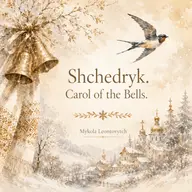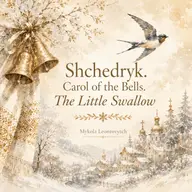

«The Night Before Christmas» was written by Gogol on a Ukrainian theme, showing the preparations and celebration of Christmas with all the traditions of caroling, dressing up, visiting neighbors’ houses with good wishes, and folk festivities. In the Munich director’s interpretation, however, there was almost no trace of Ukrainian culture, except for original words of Ukrainian origin in the libretto and carols translated into Russian to Rimsky-Korsakov’s music. The Ukrainian carols themselves — Shchedryk above all, known in the West as Carol of the Bells — survive elsewhere: they belong to the Christmas scores and the Ukrainian music I arrange and play.
The first thing that catches the eye is the decorations and costumes. Two-story metal structures with ladders frame the stage. The choir’s clothing more closely resembles Soviet attire of ordinary people. The soloists were dressed in clown costumes, with makeup applied to their faces, likely to emphasize the comic aspect of the characters. Even the young woman singing, who is quite attractive, wore a dress lacking appeal. In this portrayal, the Ukrainian cultural context is barely noticeable. Among the voices, the bass Dmitry Ulyanov in the role of Chub and soprano Elena Tsalagova in the role of Oksana stood out.
What upset me most was the beginning of the second act, where the ballet dancers performed stylized Middle Eastern dances in the costumes of Arabian concubines. Later, the same dancers appeared wearing crowns and tutus instead of Ukrainian Cossacks, who were supposed to have an audience with the Empress. The Cossacks were replaced by bearded men in women’s clothing, dancing under the dress of Catherine II, who descends from the ceiling sitting on a throne supported by two eagles, clearly emphasized as a symbol of the Russian Empire. Afterwards, the ballet performers twisted her legs up to the knees along with her boots. The plot about Vakula meeting the Devil and their subsequent journey to St. Petersburg was entirely omitted.
It can be stated that in Germany, operas by Russian composers are successfully staged, supposedly on Ukrainian themes, and tickets are impossible to get. Any references to the Ukrainian origin of the characters are removed, the roles are mostly performed by Russian singers, and enormous symbols of the Russian Empire are added instead. As a result, the performance leaves not so much an artistic impression as a sense of the work’s lost identity, which can be especially sensitive for Ukrainian audiences. The work is clearly oriented toward a Russian audience. The production touches on complex themes related to cultural heritage, while the display of a “shared past” can be perceived as an attempt to justify historical events and blur historical boundaries.